
Who Sinned?
Seeking Better Questions in the Presence of Suffering

“As he walked along, he saw a man blind from birth. His disciples asked him, ‘Rabbi, who sinned, this man or his parents, that he was born blind?’ Jesus answered, ‘Neither this man nor his parents sinned; he was born blind so that God’s works might be revealed in him. We must work the works of him who sent me while it is day; night is coming when no one can work. As long as I am in the world, I am the light of the world.’ When he had said this, he spat on the ground and made mud with the saliva and spread the mud on the man’s eyes, saying to him, ‘Go, wash in the pool of Siloam’ (which means Sent). Then he went and washed and came back able to see.”
John 9:1–7 (NRSV)
Introduction: Walking Into Someone Else’s Suffering
There is a particular kind of cruelty that arrives wearing the costume of theology. It does not announce itself as unkind. It comes dressed in the language of reason, of cause and effect, of a tidy universe where suffering always has a satisfying explanation. It asks questions, but the questions themselves do harm.
It is the Fourth Sunday in Lent, and the lectionary sets before us one of the most vivid scenes in John’s Gospel: Jesus and his disciples walking along a road when they encounter a man who has been blind from birth. We are not told his name. We are not told where he was sitting or how long he had been there. What we are told is that he was simply “along the way,” as if John means for us to understand that people in need are always along the way, if only we will see them.
But before anything redemptive can happen, before Jesus speaks a word of healing, the disciples do something profoundly human: they ask a bad question.
“Rabbi, who sinned, this man or his parents, that he was born blind?”
Seven words of theology. A lifetime of damage. This Lenten season, we have been invited to pay attention to the questions we ask: What assumptions do we carry? What is our intent? When we seek clarity or understanding, what are the better questions? John 9:1–7 gives us a laboratory for exactly this kind of examination.
I. A Bad Question and What It Reveals
To understand the weight of the disciples’ question, we need to understand the theological world they were inhabiting. The retributive principle, that suffering is the direct consequence of sin, was a dominant framework in Second Temple Judaism, though by no means the only one. It was the theology of Job’s friends. It is echoed in Deuteronomy’s blessings and curses. It appears in the Psalms. It made a kind of moral sense: a righteous God rewards righteousness and punishes wickedness. Therefore, suffering must mean sin.
But the disciples’ question carries its retributive logic into an impossible corner. If the man was born blind, and if blindness is the punishment for sin, then either he sinned before his birth, perhaps in the womb, a notion some rabbinical traditions did entertain with reference to Jacob and Esau, or his parents sinned and the punishment was transferred to the child. Both options are theologically disturbing. The first suggests prenatal guilt. The second makes God the author of innocent suffering through inherited punishment, which strains the very concept of divine justice.
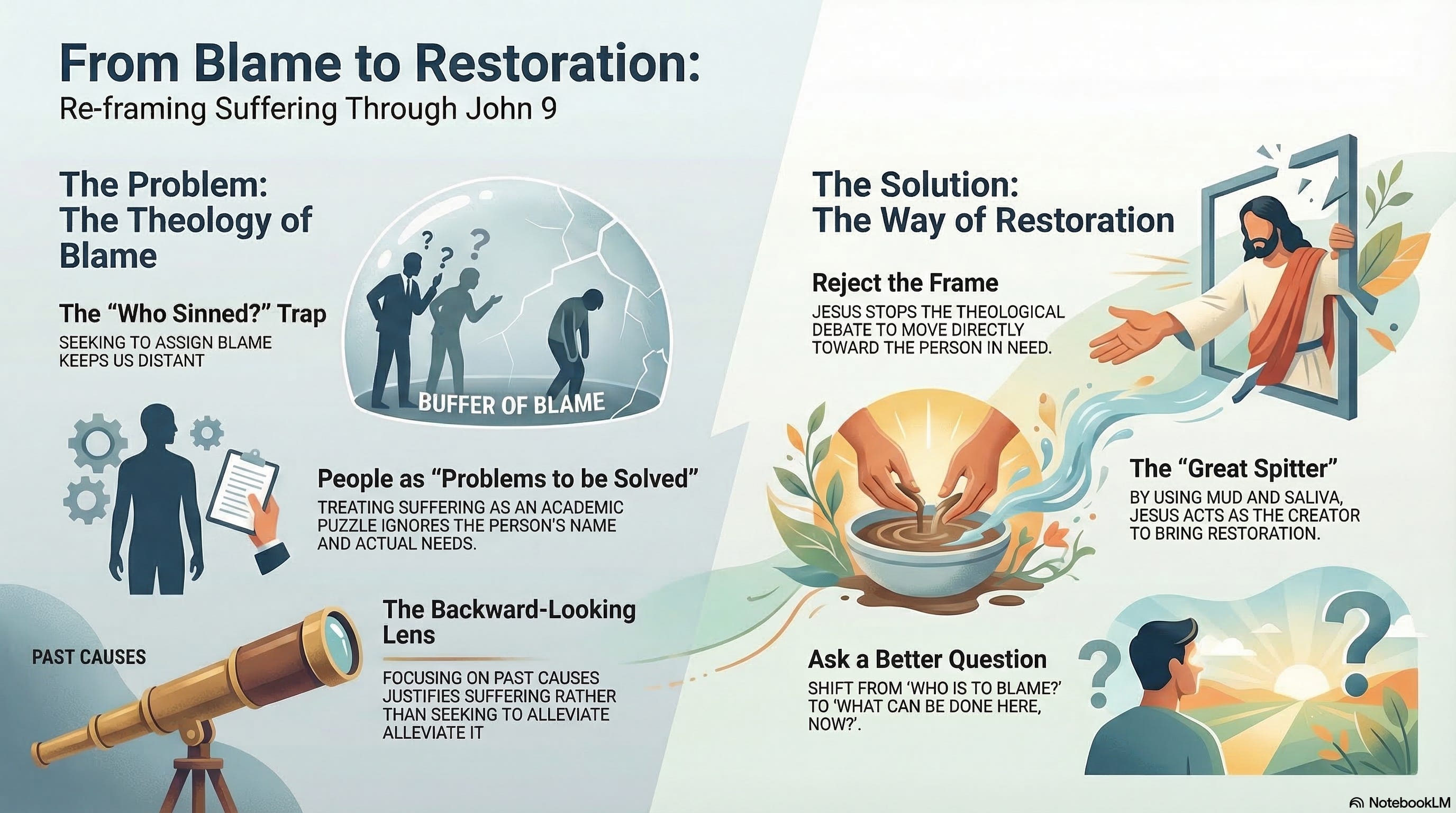
Notice what the question does not do. It does not ask the man his name. It does not ask him how he is, what he needs, or what his life has been like. It does not even address him at all. He is right there, and they talk about him as if he is an exegetical problem to be solved rather than a person to be encountered. He becomes a case study in theodicy.
This is the first and most important thing to see in this passage: the disciples’ question, however sincere its theological intent, is a form of dehumanization. When we reduce people to the categories that explain their suffering, we lose them. We stop seeing them. We become like those who are, in the language of John’s Gospel, present but not truly seeing.
The question also reveals something about intent. The disciples are not asking how they can help. They are asking who is to blame. There is a crucial moral difference between those two questions. One turns toward the person in need. The other turns toward an explanation that, conveniently, allows the questioner to remain at a safe interpretive distance. If suffering is the consequence of sin, then it is, in some sense, deserved, and that conclusion, however quietly held, excuses us from the discomfort of solidarity.
II. Jesus Refuses the Frame
Jesus does not take the bait. He does not enter the either/or logic of the question. He does not adjudicate between prenatal sin and parental guilt. Instead, he does something remarkable: he changes the question entirely.
“Neither this man nor his parents sinned.” Full stop. Jesus clears the theological underbrush with a single sentence. He is not saying sin doesn’t exist or that human actions have no consequences. He is saying that this man’s blindness is not a punishment. The retributive framework does not apply here. And by extension, and this is the radical implication, Jesus is suggesting that we should be deeply suspicious of that framework whenever we encounter suffering.
What follows is even more striking: “he was born blind so that God’s works might be revealed in him.” This sentence has been misread, and badly, throughout church history. On a careless reading, it sounds as though God deliberately blinded this man at birth, consigned him to decades of darkness, dependence, and marginalization, simply so that Jesus could stage a miracle. That would be a monstrous theology, making God a director who harms his actors for the sake of the drama.
Serious exegetes have wrestled with this, and there is good reason to read the Greek differently. The “so that” (hina) can express result rather than purpose, not “In order that,” but “in such a way that.” The man’s blindness was not engineered by God for this moment; rather, now that Jesus is here, this moment becomes the occasion through which God’s work of restoration can be seen. Suffering is not purposeless, but God does not author suffering as a screenplay device. God enters into suffering and transforms it.
Notice also the urgency Jesus brings: “We must work the works of him who sent me while it is day; night is coming when no one can work.” Jesus does not pause to finish the theological discussion. He does not wait until the disciples are fully satisfied with his answer to the who-sinned question. He turns toward the man, toward the need, toward the work. The best response to a bad theological question about suffering is often not more theology, it is action. It is presence. It is movement toward the one who is suffering.
III. Mud, Spit, and the Scandal of the Particular
And then Jesus does something that, to the modern reader, might seem strange, even off-putting. He spits on the ground, makes mud with the saliva, and spreads it on the man’s eyes.
Why? Why not simply speak a word, as he does elsewhere? Why the mud, why the spit, why the physicality of it all?
There are several layers worth excavating here. First, the act deliberately evokes creation. In Genesis 2:7, God forms the human being from the dust of the ground. Jesus, kneeling in the dirt, using earth and moisture, is re-creating. He is doing what the Creator does. John’s Gospel, which begins “In the beginning” in direct echo of Genesis, is drawing that line unmistakably. The healer is the Creator. The one making mud is the one who made the world.
Second, the use of saliva had deep roots in the healing traditions of the ancient world. In Roman medical culture, saliva, particularly fasting saliva, the first of the morning, was considered to have therapeutic properties. Pliny the Elder discusses this. Tacitus records the Emperor Vespasian healing a blind man with his saliva. The gesture would have been immediately legible to John’s audience as a healing act.
IV. The Great Spitter: A Story of Providence and Translation
Here the story of Scripture’s transmission across cultures becomes genuinely astonishing, and I want to pause and tell you a story that I first heard years ago, one that has stayed with me ever since.
There was a missionary who had given years of his life to translating the Bible for a remote indigenous people. The work was painstaking. He learned their language, studied their traditions, rendered the Greek and Hebrew into words they could hear and hold. He translated the Gospels, the letters, the histories. And yet, for all of it, something was not landing. The people listened. They acknowledged the accounts. But belief, that deep, transforming, life-reorganizing belief, did not come.
Until he translated John 9.
When the people heard that Jesus had healed a blind man by spitting on the ground and making mud, something cracked open. Because in their religious tradition, certain gifted individuals were known as “spitters”, healers who used saliva as the medium of their restorative power. Spitting was not incidental. It was not strange or crude. It was, in their cosmology, the very sign of divine healing authority. And more: there was a prophecy woven through the fabric of their ancient tradition, a promise passed from generation to generation, that one day the “Great Spitter” would come, one whose healing would not be partial or temporary or local, but would extend to the whole world.
When the missionary read aloud the words of Jesus, kneeling in the dust, spitting on the ground, pressing mud onto the eyes of the blind man, the people did not hear an odd miracle story from a foreign culture. They heard the fulfillment of their own prophecy. They heard their own longing answered. They heard the Great Spitter had come.
And they believed.
I have turned this story over in my mind many times. What does it mean? At one level it is a testament to the genius of the Incarnation, that God, in becoming flesh, did not arrive in a culturally neutral form. Jesus was embodied, particular, physical. He used dirt and spit and water. He touched people. And because he was that specific, that earthed, his story could echo across a thousand different human cultures and find resonance in each of them. The particularity of the Incarnation is not a limitation. It is the very mechanism of its universality.
At another level, the story is a rebuke to a certain kind of missionary imagination that assumes the Gospel must be purged of its strangeness before it can be received. The spitting was not the part that needed to be explained away or minimized. It was the part through which the Spirit was waiting to move. What looks, to educated Western eyes, like an embarrassment, the great teacher smearing mud on a beggar’s eyes, looks to others like the arrival of everything they’ve been waiting for.
And perhaps most importantly for our purposes today: the missionary’s breakthrough came not when he answered the disciples’ question, “Who sinned?”, but when he let the physical, scandalous, earthy particularity of Jesus speak for itself. He stopped explaining and started translating. He trusted the text.
V. Go, Wash, Come Back Seeing
There is one final movement in our passage that deserves attention, and it is easy to rush past: the pool of Siloam.
Jesus does not complete the healing himself. He does not remove the mud and say, “Open your eyes.” He sends the man away, to a pool, to water, to a place of washing. He tells the man to do something. He participates in his own healing. And John, ever the careful theologian, pauses to tell us what the name means: Siloam means “Sent.”
This is not an accident of etymology. It is a Johannine fingerprint. Throughout the Gospel of John, Jesus is the one sent by the Father (John 3:17, 5:30, 6:38, and many more). The very pool to which the man is sent bears the name of his sender’s identity. He is sent by the Sent One to the pool called Sent. The mission of Jesus, the missio Dei, the sending of God into the world for healing and restoration, is encoded in the geography of the miracle.
He went. He washed. He came back seeing.
Four words in the Greek. Dramatic understatement. John doesn’t linger here because he knows what comes next, the interrogations, the skepticism, the religious establishment’s determined refusal to believe what is right in front of their eyes. But for this moment, in verses one through seven, the story ends simply and completely: he could see. The work that Jesus said must be done is done. The works of God are revealed.
VI. Better Questions
So we come back to where we began: the quality of our questions.
The disciples’ question, “Who sinned?”, is a question of attribution. It seeks to assign blame. It locates the meaning of suffering in the past, in moral failure, in cause and effect. It is a question that, however dressed in theological language, ultimately serves the questioner by providing a comfortable distance from the one who suffers.
Jesus’ implicit response is a question of a very different kind. If we were to articulate it, it might sound something like: “What can be done here, now, in this person’s presence, to reveal the healing work of God?” That question moves toward. That question sees. That question requires something of the one who asks it.
This Lent, as we walk along our own roads and encounter, inevitably, people who are suffering, in our congregations, in our families, in our communities, in the news, we might ask ourselves what kind of questioners we are becoming.
When we see someone struggling with addiction, do we ask, “Who sinned?”, or do we ask, “What healing is possible, and how might I be part of it?”
When we encounter poverty, do we ask, “Why don’t they just work harder?”, or do we ask, “What are the systems that keep people in darkness, and what is the work that must be done while it is day?”
When someone we love is grieving, do we offer an explanation, “There must be a reason” or “God must have needed another angel”, or do we simply kneel beside them in the dust?
The disciples asked a question that kept them standing above the man. Jesus asked a question that brought him down to the ground. That is the difference between theology as explanation and theology as encounter.
Conclusion: The Light of the World Kneels in the Dirt
Jesus said, “As long as I am in the world, I am the light of the world.” And then, without pause, he knelt in the dirt.
That is what light does in John’s Gospel. It does not stand aloof and illuminate from a distance, leaving the darkness to be explained. It enters. It comes down to where things are broken and dark and confused. It touches the untouchable. It uses the ordinary, ground, water, saliva, a man’s obedient walk to a pool, to accomplish the extraordinary.
Lent is a season of self-examination, and the examination this passage invites is not primarily about the state of our beliefs but the quality of our attention. Are we looking at the people along our way? Are we asking questions that humanize or questions that categorize? Are we moving toward need, or standing back in the comfortable posture of explanation?
The man born blind did not receive a theology lecture. He received mud on his eyes and a direction to walk. He received the specific, physical, incarnate attention of a God who was not too refined to spit.
The Great Spitter came. And he is still coming, still kneeling in the dirt with each generation, still making something from nothing, still sending the blind-made-seeing back into their communities as living testimony.
May we be the ones who see him. And seeing him, may we become, ourselves, the kind of people who kneel.